

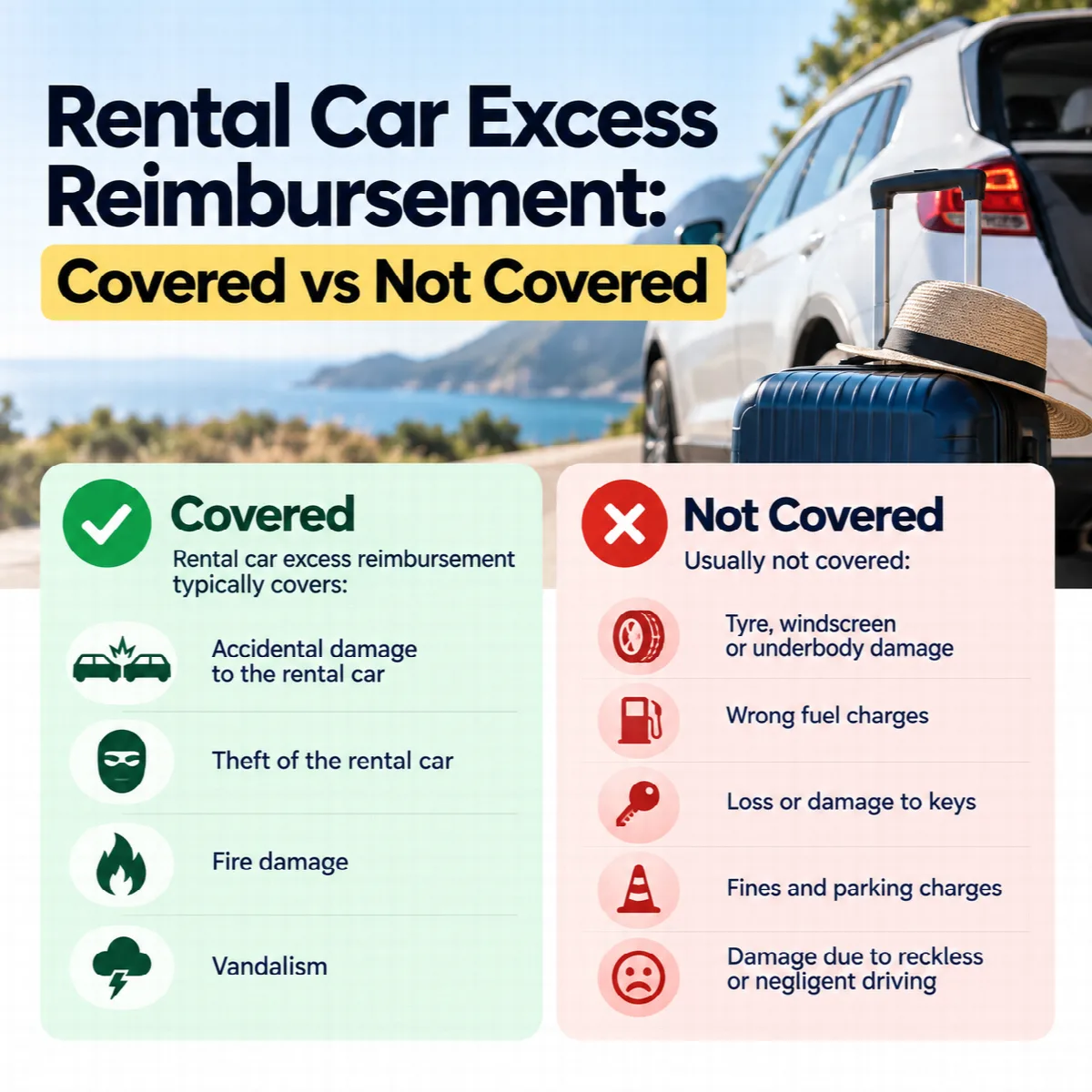
Does excess reimbursement cover everything if I damage a rental car?
No. Excess reimbursement is a separate product that refunds the excess (the amount you owe the rental supplier after damage or theft) plus some related charges, up to a stated limit. You pay the supplier first and claim the money back afterwards. It does not cover interior damage, cleaning, damage to other people or their property, or damage that happens while you are breaking your rental agreement.
This article uses DiscoverCars' optional Full Coverage as the worked example, because it is the product sold on the booking partner Cars Renta links to. Cars Renta is a comparison site. It does not sell, underwrite or administer any cover, and it cannot change a claim. The cover is sold by DiscoverCars or by the rental supplier. All terms below come from DiscoverCars' published pages and can change, so check your own voucher.
What is the excess, and how is it different from a waiver?
A Collision Damage Waiver (CDW) is a term in the rental contract that limits what the supplier can charge you if the car is damaged. Industry guides describe it as a waiver rather than true insurance, and note that it is usually part of your rental agreement and often leaves an excess.
The excess (also called the deductible) is the ceiling on what you can be charged. DiscoverCars describes it as the maximum amount you'd be asked to pay if the car is ever damaged or stolen. You can find it in the Rental Conditions of your booking.
In a standard accident, the supplier's CDW covers the portion of the damage above your deductible, while Full Coverage reimburses the deductible you paid. Those are two different layers from two different sellers.
Who sells excess reimbursement, and is it insurance?
Rental suppliers sell their own products at the desk, such as a Super CDW that usually reduces your excess to zero. Excess reimbursement is different. It is bought separately, and you claim the money back later.
DiscoverCars describes Full Coverage as an agreement directly between you and DiscoverCars.com, completely separate from the rental supplier. One travel blog reviewing the product says it is an excess reimbursement protection rather than a traditional primary insurance policy. The same blog says some European residents are shown a different product, Sincera, underwritten by Sincera and with its own wording and claims process. Which product you are offered depends on your booking, so read the wording shown at checkout.
What does Full Coverage reimburse?
DiscoverCars states that Full Coverage can refund the deductible (excess) and other damage-related costs you may pay the rental company if the car is damaged or stolen, with compensation up to €5,000 in total. The exact limit for your booking is on your voucher.
Its published list includes:
The excess under the car's basic insurance for accident or vandalism damage, and the excess for theft of the whole car (not individual parts).
Tyres, wheels, windows, mirrors, hubcaps and lights, plus bodywork, roof and undercarriage, which standard CDW often leaves out.
Damage caused by an unidentified third party, excluding traffic violation cases.
Administrative fees, towing, taxi expenses or loss-of-use charges, within the same total limit.
Wrong-fuel costs: draining and repairing the fuel tank if the wrong fuel is used.
It also covers the main driver and all additional drivers named on your rental agreement. For cross-border trips, the supplier must have given permission, noted on your rental agreement.
How does the limit work in practice?
DiscoverCars gives an example: the car has €5,000 of damage and the contract excess is €1,000, so the supplier's CDW pays the remaining €4,000. You pay the €1,000 to the supplier and then claim it back through Full Coverage. The refund is capped by the limit on your voucher. Amounts are calculated at the exchange rate when your claim is processed, not when you booked.
What is not covered?
This is where renters most often get caught. According to DiscoverCars' published terms, these are not covered:
Interior damage and special cleaning. Interior damage and special cleaning fees, such as for sand, mud or pet hair, are not covered unless they result directly from a collision.
Damage to third parties. Damage to third parties is not covered. Third-party liability is a separate cover. It is usually included in Europe but is often an optional add-on in the Americas, so check the "Rate Includes" section.
Breaches of the rental agreement. The terms exclude damage that occurred while you were not complying with the rental agreement or local laws, such as driving under the influence, driving off-road or committing a traffic violation.
A missing CDW. If your booking does not include CDW, you still need your own insurance or must buy it at the desk. Full Coverage does not replace this requirement.
Rental extensions arranged at the desk. Extensions agreed directly with the rental company are not covered.
Traffic fines, tolls, fuel and late returns. DiscoverCars' terms say the customer must reimburse the company for car damages, cleaning fees, late return charges, traffic fines, tolls, missing fuel, administrative charges and applicable deductibles. Its administrative-fee cover excludes fees for traffic violations, tolls, fuel, cleaning or late returns.
The most serious case is a contract breach. DiscoverCars says that if the rental contract is breached, the supplier's CDW becomes void, you may be held fully liable for the vehicle's value, and Full Coverage will not reimburse you.
Does it remove the security deposit?
No. The supplier's deposit is a separate matter from the excess. The supplier cannot see the cover in its system, so you still leave a standard deposit using a credit card in the main driver's name. DiscoverCars states that Full Coverage does not remove or reduce the supplier's security deposit requirements.
At the desk, agents may say your cover is not valid. DiscoverCars says this usually means the reimbursement cannot replace their deposit requirement, and that Full Coverage remains valid as reimbursement protection for eligible damage costs and related fees. Because the supplier sells its own waivers, it has a commercial interest in you buying them. Decide before you arrive whether you want to.
How do I make a claim, and how long do I have?
You pay first, then claim. The steps published by DiscoverCars are:
The supplier charges you for damage and related fees under the rental agreement.
You collect the documents. DiscoverCars lists the signed rental agreement (not the online voucher), the damage report with photos, and the supplier's final invoice.
You submit the claim through the claim form in "My Booking". You give your bank or PayPal details.
DiscoverCars reviews it. Most claims are reviewed within 5 business days, though complex cases may take up to 28 calendar days.
What is the claim deadline?
DiscoverCars' pages disagree. Its main help pages say to file within 90 days of dropping off the car. Older help-centre articles say within 28 days of dropping off the car or of the date the car broke down, was damaged or was stolen. The help-centre page for late charges says that after 28 days you can no longer file through My Booking and must send a compensation request through the Help Center.
Do not rely on the longer figure. Check the deadline on your voucher and file as soon as you receive the supplier's final invoice. Only DiscoverCars can decide or change a claim.
Also note that DiscoverCars' terms say a refund must be returned if you later become eligible for reimbursement from the rental company, for example if you were found not to be the at-fault driver.
What should I check before I book?
Your excess figure. It is in the Rental Conditions, and it varies by supplier and vehicle.
The Full Coverage limit on your voucher. If the excess is close to the limit, there is little room for extra fees.
What "Rate Includes" lists. Confirm CDW, theft protection and third-party liability are there.
Your card's credit limit. A deposit hold is still needed.
The photos you take. Photograph the car at pick-up and drop-off, because the claim depends on the damage report.
Cover terms are set by the supplier or DiscoverCars, not by this site. To see excess figures next to prices, use live price search. For how the base price is built, see how rental pricing works. For what Cars Renta does, see about Cars Renta.