

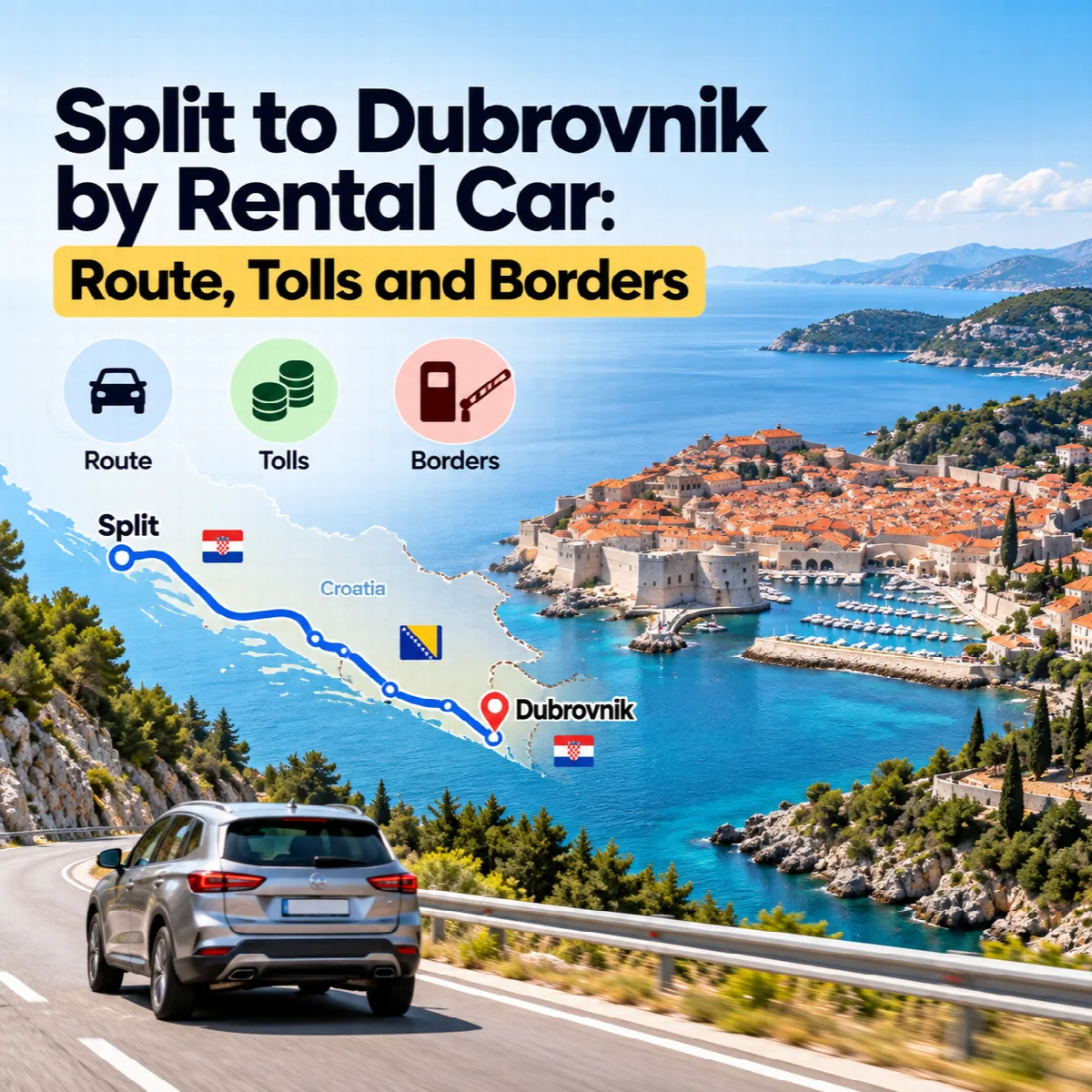
How do you drive from Split to Dubrovnik in a rental car?
Take the A1 motorway south from Split to Ploče, then the D8 road across the free Pelješac Bridge and on to Dubrovnik. One mapping check found the drive is 236 km and takes 3 hours 13 minutes, with no border crossings. Expect a motorway toll of roughly €7–8, and no vignette (a prepaid windscreen sticker) is needed.
This guide covers the route, tolls, what visitors need to rent and drive, one-way fees, and the border rules that changed in 2026. Figures come from the sources listed at the end. Toll prices and supplier fees change, so check them before you travel.
What is the best route between Split and Dubrovnik?
There are two main choices: the motorway and the coast road.
The motorway route
From central Split, head to the Dugopolje entry to the A1 and follow it for about 100 km to its end at Ploče. Because the A1 ends near Ploče, southbound traffic generally switches to the D8 state road. That road now runs over the Pelješac Bridge.
The coast road
If you have time, take the coast road from Split to Ploče. It passes through Omiš and the Makarska Riviera. These roads are very slow in high season, so expect 4–5 hours, though it is faster in low season.
Via Ston
Ston is worth a stop, and lunch there suits well. The town is known for mussels and local wine. The Ston bypass, opened in April 2023, also lets buses and heavy trucks use the bridge.
Do you still have to cross into Bosnia?
No. The Pelješac Bridge opened in July 2022 and bypasses the border crossing into Bosnia and Herzegovina. Before it opened, travellers going between Dubrovnik and mainland Croatia passed two border checks within 9 km. That stretch is the Neum Corridor, a short strip of Bosnian coast.
The bridge is 2.4 km long and free to cross. It is limited to vehicles travelling faster than 60 km/h, so nobody can walk across it.
Is the Neum Corridor ever worth using?
It can be 7 km shorter. It was 12 minutes faster if there was no border queue. One local reported waiting under two minutes at each crossing out of season, but up to two hours each in season. For most visitors the bridge is the safer choice, especially in summer.
What if you want to avoid both?
A car ferry from Ploče to Trpanj on the Pelješac peninsula runs seven times a day in peak summer and four times a day off-season. The crossing takes one hour. Ferry timetables change, so check the operator, Jadrolinija, before relying on it. Some suppliers also add a fee or need approval for ferries. One supplier lists a €30 per-rental ferry insurance fee and requires pre-approval. Ask before booking.
How do tolls work on this route?
Croatia has no motorway vignette. The A1 uses a ticket system, so each exit has a toll plaza. You take a ticket when you join and pay when you leave.
Cost: Tolls from Split to Dubrovnik come to around €7–8. An older figure was €6.70 for category 1 vehicles as of January 2023. Treat both as approximate.
Currency: The kuna has not been accepted since 1 January 2023, and all booths take euros.
Cards: Visa, Mastercard and Maestro are accepted at almost all booths. American Express is not always accepted. Carry a little cash in case.
Bridge: There is no toll on the Pelješac Bridge.
Car class: Cars under 3.5 t fall into two price categories, split at 1.9 m vehicle height. A standard hire car is normally in the lower one.
What licence do visitors need?
A valid home licence is enough for most visitors, but supplier rules vary.
EU, EEA or Swiss licence: It remains valid in Croatia with no International Driving Permit (IDP) required.
UK licence: UK holders are recognised as visitors for up to 12 months.
US, Canadian, Australian and other Latin-script licences: An IDP is generally not strictly mandatory. Some rental agencies request one as standard anyway.
Non-Latin scripts (Arabic, Chinese, Cyrillic, Korean): Travellers from Korea should carry an IDP because of the different language on the licence.
An IDP is a booklet that translates your licence. It does not replace your regular licence. You need the original, physical licence, because digital versions, photocopies or screenshots are not accepted.
Age and experience rules depend on the supplier. Most set a lower age limit of 21 and expect one to two years of licence history. A credit card is commonly required for the security deposit. Read the terms on the offer page before you book.
Do one-way rentals between Split and Dubrovnik cost extra?
Often, but not always as a separate line. Most companies charge a one-way fee for a different drop-off location, and it varies by provider. One Croatian supplier quotes about €150 for this coastal trip. Another source says most companies build the fee into the base rate on the Dubrovnik–Split corridor.
The practical step is to compare the total price with different drop-off points. A drop-off at another branch in the same city is typically free. You can run a live comparison on the booking search page, and the pricing guide explains how fees like this are built into a quote.
What border rules apply if you extend the trip?
Two changes matter for 2026: the Entry/Exit System and cross-border fees.
Entry/Exit System (EES)
The EES registers non-EU nationals entering or leaving the external borders of Schengen countries for short stays. Croatia has run it at all its international crossings since 1 March 2026, and the EU-wide rollout finished on 10 April 2026. Passports are no longer stamped, and fingerprints and a facial image are recorded on the first crossing. EU, EEA and Swiss citizens are not registered.
ETIAS, the EU's travel authorisation, was not yet in operation as of the latest check in August 2026. Verify this on the official EU site before you travel.
Cross-border fees and Montenegro
The usual add-on is a trip from Dubrovnik to Kotor in Montenegro. That drive takes about 90 minutes. The Karasovići–Debeli Brijeg crossing is open 24 hours and is about 50 minutes from the Old Town. Waits run from under 10 minutes off-season to up to two hours at the worst weekend times.
You must tell the supplier in advance. Cross-border fees typically run from €10 to €50 per rental, depending on supplier and destination. Some suppliers charge more, and one lists €70. Green card rules are inconsistent between sources. One source says a green card has not been required within Europe since 2 August 2021. Other guides still describe it as essential for Bosnia and Montenegro, so ask the supplier what paperwork they will provide.
What should you check before you book?
Confirm the licence and IDP rules in the offer's terms.
Compare one-way totals, not just daily rates.
Declare Bosnia, Montenegro or ferry plans at booking.
Bring euros and a card for toll booths.
Leave early on summer weekends if you plan to cross any border.
Browse the vehicle catalogue to match car size to luggage, since coastal roads and Dubrovnik parking favour compact cars. Cars Renta is a comparison site and does not hold reservations, so changes to a booking go through the booking partner.
I found no seasonal closure or special permit for this route in the sources I checked. Check live traffic and weather before departure all the same.